
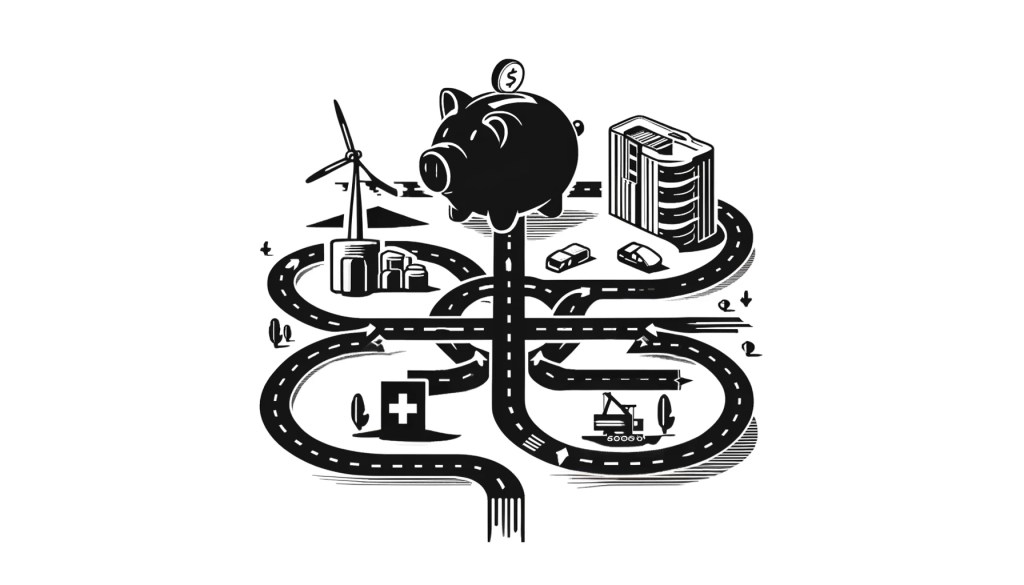
The purpose of the financial system is transferring money to those who need it today, from those who don’t, in exchange for a return.
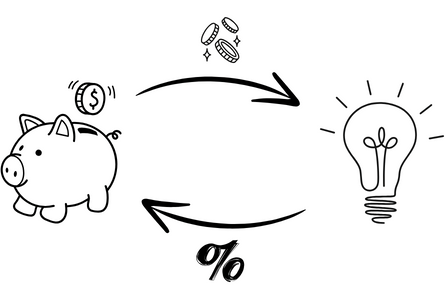
This transfer occurs indirectly through intermediaries such as banks, or directly through the capital markets.

Banks play a crucial role. When money enters your account, the bank holds a small portion as a ‘reserve’ and uses the rest to grant loans to other customers. This means your savings become someone else’s debt. Banks pay interest on your savings and charge higher interest on the loans they provide — this is how banks make money. It’s important to understand that banks grant loans ‘on their own behalf‘, meaning they assume the risk when people fail to repay their debts.
In the capital markets, there are also intermediaries like financial advisors and stockbrokers, but they operate ‘on your behalf‘, meaning you assume the risk. These intermediaries simply advise, manage, or facilitate investments in your name. The capital markets provide financing for companies and allow you to acquire shares, bonds, and other valuable assets, with the expectation of future economic gain. To invest in these assets, there are two types of markets: the stock exchange and the private market.
Imagine living in a village with many local farms and a well-stocked supermarket. If you need to buy food, you have two options: you can buy from the supermarket, where each product is clearly labelled and guaranteed by quality controls, or you can buy directly from local farms, where you will need to negotiate prices and quantities with each farmer and check the quality of the products yourself.
Think of the stock exchange as a supermarket, while the private market is like buying from a neighbour’s farm. It’s not a perfect analogy, but I hope it helps you understand the difference.
The stock exchange is where investors can quickly and easily buy and sell financial assets. This is achieved by splitting the equity and debt of companies into small, equal parts. Equity is divided into ‘shares’, while debt is divided into ‘bonds’. The constant flow of investors wanting to buy and investors wanting to sell causes the price of assets to move up and down, reflecting the ‘market price’ at any given moment.
The stock exchange offers advantages such as greater access (any investor can participate) and liquidity (ease of selling your assets), in addition to providing companies a “showcase” to raise funds when needed. In return, companies commit to transparency and to act under the scrutiny of the law.
The private market is less transparent, and the buying and selling of assets is more complicated, requiring more experience from investors.
To invest in a private asset, the buyer must find someone willing to sell, and both parties must agree on the price and quantity. While listed assets on the stock exchange have a visible and constantly updated market price, the price of assets in the private market can only be known at the time of the transaction.
This can give the false impression that investing in property is “safer” since there isn’t a display showing the minute-by-minute price of your properties. As the saying goes, “out of sight, out of mind”.
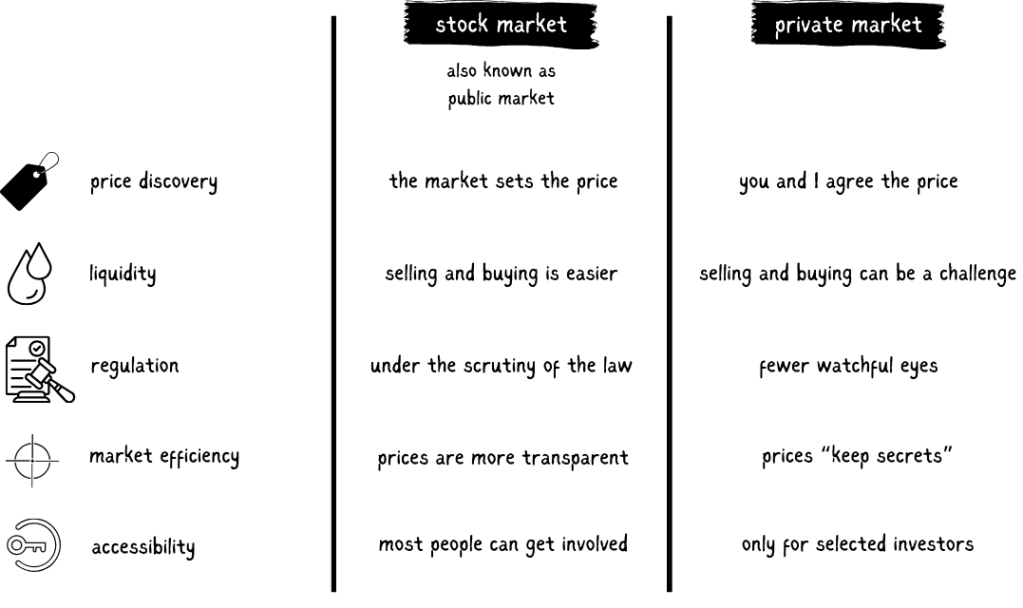
In summary:
The financial system acts as a bridge between investors’ capital and assets. Knowing the route is important, but that doesn’t mean you want (or know how) to drive.
Investing on your own carries risks and requires a lot of experience and time. Fortunately, you have other options. It’s time to talk about investment funds.

 MoneyStudio